
At a glance
Use an eTMF inspection readiness checklist to test completeness, quality, timeliness, access, vendor handoffs and record retrieval.

Original AI-generated editorial illustration.
An eTMF inspection readiness checklist should test whether essential records allow a reviewer to understand what happened during a clinical trial, who was responsible and how important decisions were made. It should cover completeness, document quality, timely filing, access, traceability and retrieval. A tidy folder structure or a high completeness percentage cannot answer all of those questions.
Use the checklist during study conduct rather than saving it for an inspection announcement. A late exercise can locate missing records, but it cannot recreate contemporaneous decisions that were never documented. Readiness is stronger when teams regularly examine whether their records tell a coherent and credible account of the study.
Map the full record landscape
Identify the repositories, systems, organizations and individuals holding essential information. The eTMF may contain the filing structure while important evidence remains in safety systems, data platforms, vendor portals or investigator-site files. Record where the authoritative version resides and how the relationship between distributed records is maintained.
The EMA guideline on trial master file management and archiving provides context for sponsor and investigator records, electronic systems and record control. Confirm the requirements applicable to the investigation before applying a generic checklist. The operational tests below help organize a review; they are not a universal list of every required document.
Reconcile expected records with actual activity
Build expectations from the protocol, study milestones, countries, participating sites and outsourced activities. Ask whether the record should exist yet, who creates it and where it should be filed. A checklist that treats all documents as expected from study start can produce misleading gaps and encourage meaningless placeholders.
For a hypothetical site initiation, compare the actual timeline with the records that explain readiness, delegation, training and relevant approvals. Follow any changes after initiation. The question is not whether the folder contains familiar filenames, but whether the evidence supports the activities that actually occurred at that site.
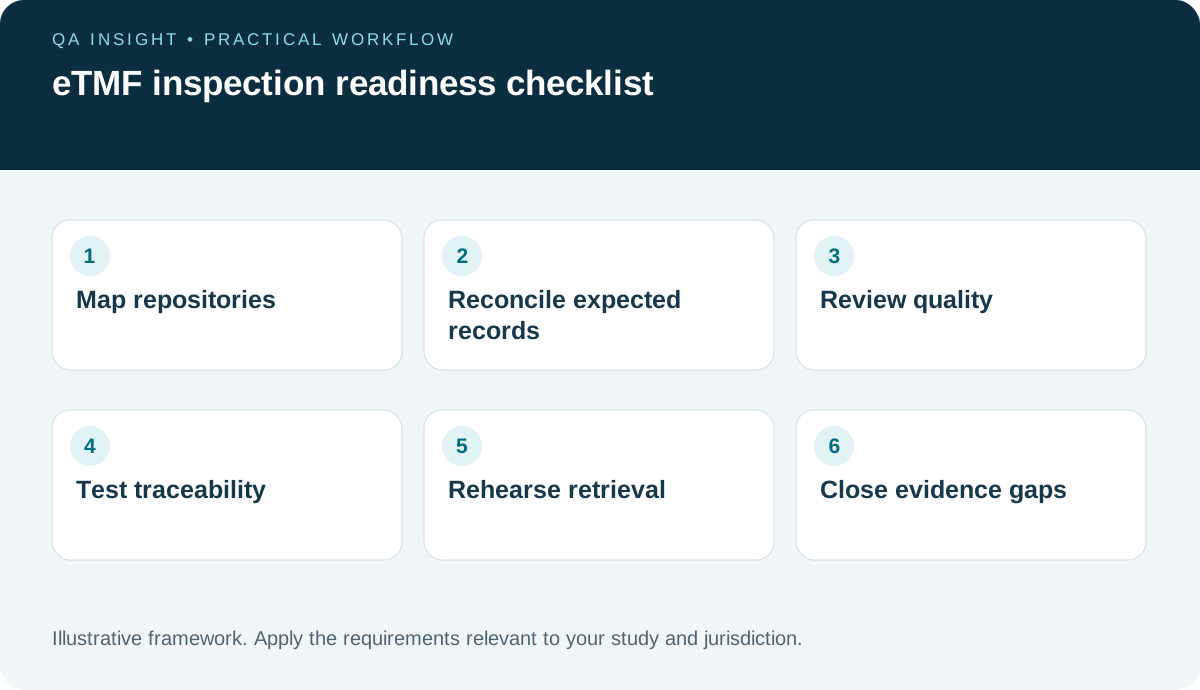
Examine document quality and context
Sample records for legibility, appropriate approval, correct version, accurate identification and useful context. Check that attachments referred to in an email or report are available. Look for records filed against the wrong study, site or period, and for duplicate versions that make it unclear which record was used operationally.
Review discrepancies proportionately. A minor naming error and an absent approval for a consequential decision are not equivalent. Explain the impact and the necessary response. The site's clinical quality management documentation review article offers related context for separating administrative neatness from evidence that can support an independent assessment.
Test timeliness instead of counting uploads
Compare when a record was generated, when it became available and when it was filed or made accessible. Investigate patterns rather than relying on a single average. A burst of uploads immediately before review may improve a completeness measure while concealing a persistent problem with routine filing or vendor handoffs.
Identify the practical cause of delay. Approval workflows, unclear ownership, inaccessible portals and inconsistent metadata may each require different action. Avoid assuming that every delay is a training problem. Where the weakness is recurring, connect the response to a clear owner and planned CAPA effectiveness checks.
Follow decisions across linked records
Select a few important study decisions and reconstruct the evidence trail. A protocol change might involve a rationale, review, approval, communication, training and implementation records. Check whether a reviewer can follow those relationships without relying entirely on the memory of the person who managed the change.
This method reveals gaps that folder-based checking can miss. All expected document types may be present while the relationship between them is unclear. A useful record trail should explain the sequence and the decision, including any relevant exceptions. For digitally generated information, consider how audit-trail review supports that reconstruction.
Rehearse access and retrieval
Ask someone who did not prepare the file to retrieve a defined set of records. Confirm that access permissions, search tools, export functions and viewing software work as intended. Include records held by vendors and clarify who can supply them if the usual contact is unavailable.
The exercise should reflect a realistic review question, not a race to open a familiar document. Record difficulties such as unexplained abbreviations, broken links, missing metadata or incompatible exports. Do not assign a universal retrieval-time benchmark without considering the study context. Set and justify any internal service expectation that the team actually needs.
Clarify vendor handoffs and study closeout
Before a vendor engagement ends, agree the transfer format, record inventory, metadata, access arrangements, reconciliation process and responsibility for unresolved gaps. Test a sample transfer before the final handoff. Waiting until closeout can leave the sponsor dependent on an expired portal or an individual who has moved to another role.
Use clinical vendor quality agreements to define these interfaces. The related discussion of clinical QA services for CRO oversight explains why a sponsor needs evidence of how outsourced work is controlled, rather than simply an assurance that the vendor maintains a complete file.
Test the file without its usual owner
Ask a colleague to answer a specific question using the available records while the usual file owner observes silently. For example, ask how a revised instruction reached a particular site and how implementation was confirmed. Note every explanation that depends on undocumented personal knowledge. These observations can reveal unclear indexing, incomplete correspondence or missing links between decisions and records. Repeat the exercise after improvements. The aim is not to remove professional interpretation, but to ensure that the evidence remains understandable when staff change or an independent reviewer examines the investigation.
Turn checklist findings into a readiness decision
Summarize material gaps, their implications, accountable owners and the evidence needed to close them. Distinguish issues resolved during the review from those requiring a sustained process change. Keep explanations clear enough for a study leader to decide whether additional resources, escalation or independent examination is needed.
Preserve the results of retrieval exercises and follow-up reviews. They show how readiness was evaluated and improved over time. QA Insight's clinical audit and quality services can support related assessments. A useful eTMF checklist ultimately tests whether the record supports the study's story, rather than whether the dashboard looks complete.
Primary sources and further reading
This article provides general professional information. Confirm the requirements and decisions applicable to the particular investigation.