
At a glance
Create clinical vendor quality agreements with clear responsibilities for escalation, records, changes, subcontractors and quality follow-up.

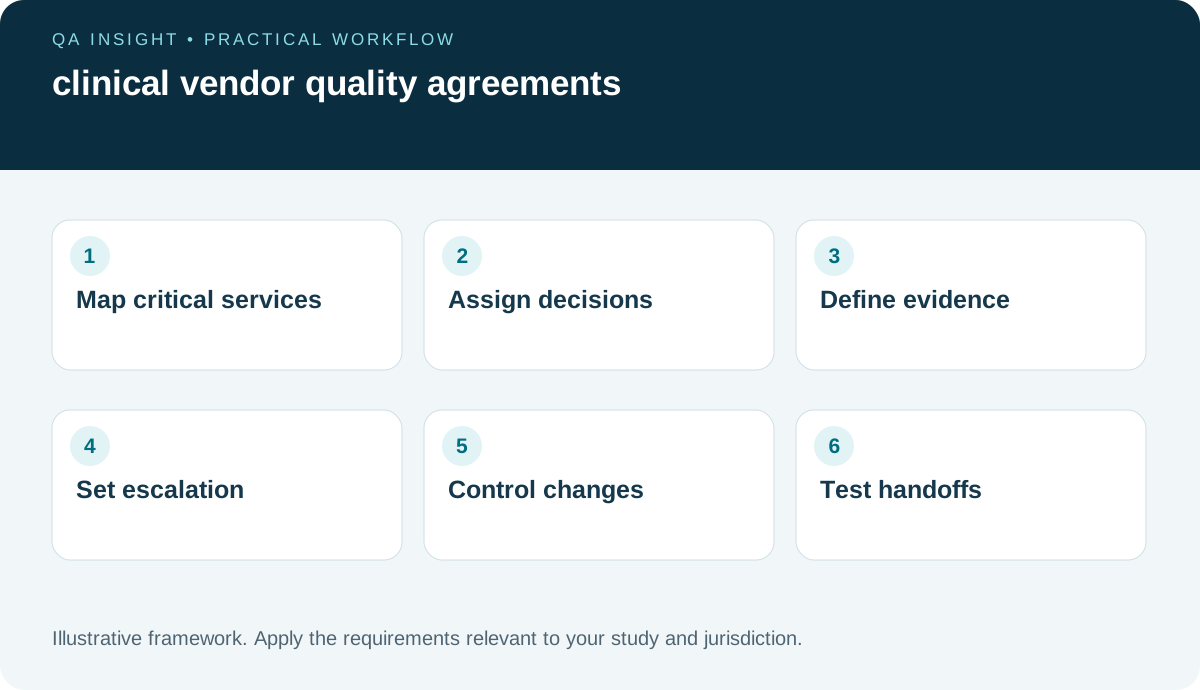
Original AI-generated editorial illustration.
Clinical vendor quality agreements describe how organizations will manage the quality responsibilities that cross their boundaries. A useful agreement identifies decisions, required evidence, communication routes, escalation and change control for the actual service. Broad promises to follow applicable requirements do not explain who will resolve a safety-critical issue, supply a missing record or approve a consequential operational change.
The agreement should support the commercial contract and the study's operating plans without silently contradicting either. It may take the form of a separate document or clearly defined contractual provisions. The appropriate format depends on the service and framework. What matters operationally is whether the parties share a workable understanding of their obligations and handoffs.
Map the service before drafting clauses
Describe the activities performed by the vendor and the information needed by the sponsor to exercise oversight. Include subcontractors, technology providers and interfaces with other vendors where relevant. A service can appear well defined at a high level while important decisions remain unassigned between the organizations carrying it out.
FDA's risk-based monitoring guidance provides related context for clinical oversight. It should not be read as requiring an identical agreement format for every service. The approach below is a practical model for defining responsibilities, supported by the applicable requirements, study needs and contract review.
Assign decisions rather than only activities
A responsibility matrix is more useful when it identifies who decides, who supplies evidence and who must be consulted. “Vendor manages deviations” leaves important questions unanswered. Who assesses significance? Who evaluates study-level impact? Who decides whether additional reporting is necessary? Who verifies that agreed actions were effective?
Use realistic scenarios to test the allocation. Consider an important record that cannot be retrieved, a recurring monitoring deficiency or a software change affecting study data. Ask each party to explain its next step. Differences in the answers often reveal an ambiguous handoff before it creates an actual study problem.
Define information and evidence expectations
Specify the records, metrics and explanations needed for oversight. Identify their source, frequency, format, recipient and review purpose. Avoid requesting information merely because it is easy to produce. The sponsor needs evidence that supports decisions, not a growing collection of status reports that nobody has the capacity to interpret.
For records held in a vendor system, agree how access and retrieval will work during routine conduct, audit, inspection and closeout. Address relevant metadata and context, not only PDF copies. The eTMF inspection readiness checklist offers practical tests for those arrangements and for reconciling distributed evidence.
Make escalation specific enough to use
Describe the types of concerns requiring escalation, the responsible contacts and the expected decision route. Explain how urgent matters are handled outside the normal meeting schedule. Any timelines should be justified by the service, risk and applicable obligations, rather than copied without context from an unrelated agreement.
Distinguish notification from resolution. A vendor can notify the sponsor promptly while the underlying issue remains unowned. Specify how the parties track decisions, actions, unresolved disagreement and further escalation. Include a route for replacing unavailable contacts so that an important concern does not depend on one named individual's continued availability.
Control changes across organizational boundaries
Identify changes requiring notification, assessment or approval, including relevant alterations to processes, systems, locations, subcontractors or key responsibilities. State the information needed to evaluate the change and how the decision will be documented. The arrangement should enable necessary change while preserving visibility into its potential effects.
For digital services, distinguish routine technical maintenance from changes that may affect intended use or important information. Connect the agreement to computerized system validation and local release decisions. A supplier's successful product release does not automatically answer every study-specific implementation question for the sponsor.
Agree how findings and CAPA are handled
Define access for relevant audits, communication of findings, impact assessment, action ownership and follow-up. Clarify which organization investigates a cross-functional problem and how information will be shared. When several parties contribute to the cause, dividing the finding into separate registers can obscure the need for a coordinated solution.
Agree the evidence supporting action completion and effectiveness. The guide to clinical trial CAPA effectiveness checks explains why a closed action is not the same as a demonstrated improvement. Keep the escalation process available when the parties disagree about the adequacy of an investigation or response.
Plan subcontracting and exit arrangements
Understand whether subcontractors perform activities important to the service and how the prime vendor controls them. Define what information the sponsor needs and how changes are communicated. The appropriate depth depends on the role and consequence of the outsourced activity; a single generic subcontractor clause may conceal substantial differences.
Plan for service termination before it becomes urgent. Address record inventories, transfers, system access, unresolved issues, retention responsibilities and continuity during the transition. Test important handoffs with sample records. An agreement that works only while the relationship is stable may leave the sponsor exposed precisely when reliable cooperation becomes most important.
Resolve the meaning of shared responsibility
Shared responsibility should not mean that each party assumes the other will act first. Where both organizations contribute, identify the lead for the particular decision and the evidence each party must provide. Consider a vendor transfer that contains incomplete records: who identifies the deficiency, who evaluates its consequence and who authorizes acceptance or further work? Document the agreed answer and test it with an example. This practical clarification is often more valuable than adding another broad assurance clause that leaves the operational sequence unchanged.
Keep the agreement connected to operations
Assign ownership for reviewing the agreement when the study or service changes. Ensure that operational contacts understand the relevant provisions and can locate them. A signed agreement should not remain solely with procurement while study teams rely on informal arrangements that differ from the documented model.
Connect this work with CRO oversight and clinical vendor oversight services. An ICH E6(R3) gap assessment can reveal where responsibilities and evidence remain unclear. QA Insight's clinical QA services provide related support. The strongest agreement is one the parties can use to reach a sound decision when an unexpected event occurs.
Primary sources and further reading
This article provides general professional information. Confirm the requirements and decisions applicable to the particular investigation.