
At a glance
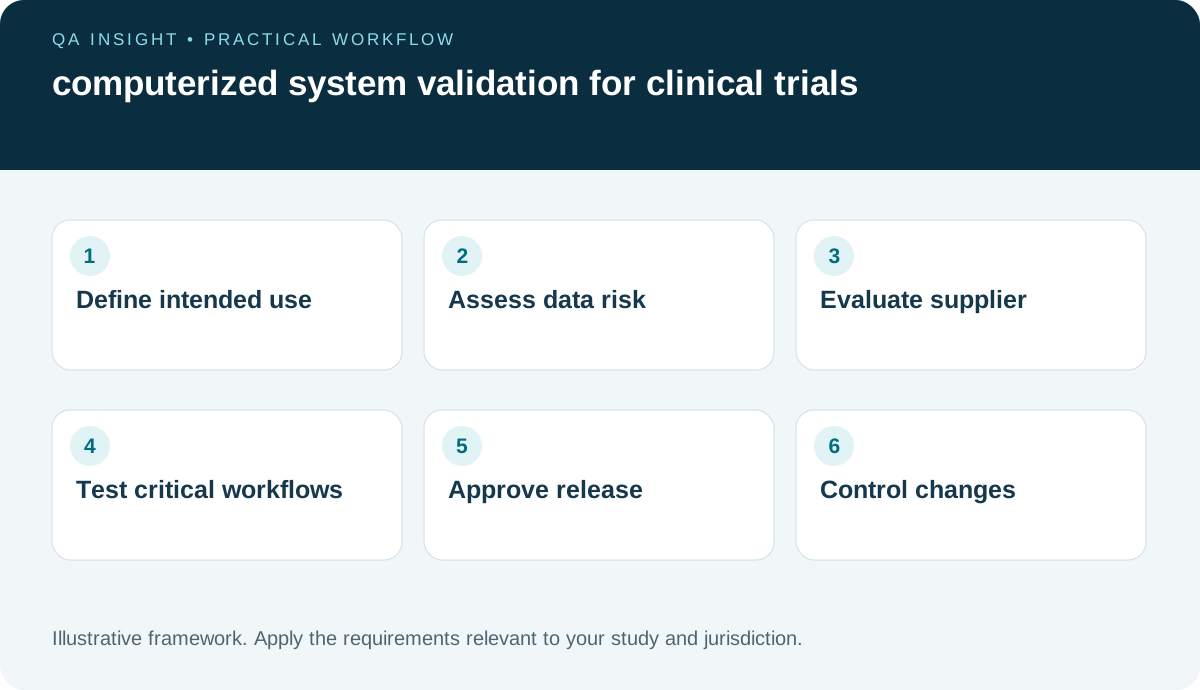
Plan computerized system validation for clinical trials around intended use, data risk, supplier evidence, testing and controlled change.

Original AI-generated editorial illustration.
Computerized system validation for clinical trials builds documented confidence that a system is suitable for its intended use and that important functions behave reliably. The work should be proportionate to the data, processes and risks involved. A purchased platform's validation package can contribute evidence, but it does not automatically demonstrate that the sponsor's configuration and actual workflows are appropriate.
Begin with the decisions the system supports. A platform used to collect a primary outcome, manage safety information or control access to essential records presents different concerns from a tool used for a low-impact administrative task. Understanding those differences helps the team concentrate its assessment and testing where failure would matter.
Define intended use in operational terms
Describe who will use the system, which records it will manage, where information comes from and what outputs will support study activities. Identify interfaces, configurations and organizational boundaries. Avoid a description so broad that it merely repeats a vendor's marketing material and gives the testing team no practical basis for selecting scenarios.
The EMA guideline on computerised systems and electronic data in clinical trials provides a relevant framework for systems and electronic information. Determine its applicability to the study and organization. The operational approach below is a planning aid rather than a universal validation protocol or a substitute for the applicable requirements.
Assess risk through the data lifecycle
Follow creation, entry, modification, transfer, calculation, review, reporting and retention. Consider failures involving incorrect values, missing context, inappropriate access, unreliable interfaces or inability to retrieve information. Link the assessment to the study's important decisions rather than rating technical features in isolation.
For a hypothetical outcome-assessment platform, a misconfigured visit window could affect which assessment is presented to a user. Testing only login and screen appearance would miss that risk. Connect the assessment with critical-to-quality factors so that the chosen scenarios reflect how information will influence the investigation.
Evaluate supplier evidence critically
Understand the vendor's development, testing, release, incident and change-control practices. Identify the evidence available for the product and version being used. Assess how the supplier manages subcontractors and service continuity where those issues affect the intended use. The depth of evaluation should follow the significance of the service.
Decide which supplier evidence can reasonably be relied upon and what remains for the organization to demonstrate. Document that reasoning. A generic certificate or an assurance that the product is compliant cannot answer every question about a particular implementation. Relevant vendor qualification resources can help connect this assessment with broader clinical quality management.
Translate important requirements into testable scenarios
Write requirements in language that permits a clear result. “The system must be secure” is too broad. A more useful scenario identifies a role, an attempted activity and the expected access behavior. Similarly, a record-retention scenario should specify the information and context that must remain retrievable, not simply that an archive button exists.
Cover normal workflows and credible exceptions. Consider corrections, rejected transfers, unexpected input, account changes, interrupted tasks and recovery. A small set of well-justified scenarios can provide more useful evidence than a large collection of screenshots that do not show the expected result or the reason the function matters.
Test the implementation, not only the product
Examine the configuration, study-specific rules, user roles, interfaces and reports that will actually be used. Distinguish supplier testing from local acceptance activities. Keep a clear link between the requirement, risk, test, result and any discrepancy. Where a discrepancy is accepted, record the rationale, impact and any remaining controls.
Include exports and record reconstruction. Can the team retrieve a meaningful record with necessary context outside the normal operating screen? The article on clinical trial audit trail review explains why event history, user context and export behavior should be assessed before relying on the resulting evidence.
Approve release with known limitations
Define who can authorize operational use and what evidence is required. Summarize completed activities, open issues, restrictions, training and support arrangements. A release decision should make remaining limitations visible rather than scattering them across test notes that an operational team is unlikely to read.
Prepare users for their responsibilities, including access requests, issue reporting and controlled changes. Training should reflect the actual workflow and relevant exceptions. A person may know how to navigate a screen without understanding which decisions require approval or which records must be preserved when an activity fails.
Maintain confidence after implementation
Assess changes to software, configuration, infrastructure, interfaces and intended use. Determine what review or testing is justified for each change. Preserve version information and the relationship between releases and study periods. A system's suitability is not established permanently by the evidence collected at its first deployment.
Review incidents and recurring support issues for evidence that assumptions are no longer sound. Where a systemic weakness is identified, use defined actions and CAPA effectiveness checks. The response should address the failure mechanism rather than simply repeating the original test script until it produces an acceptable result.
Keep the evidence understandable after the project ends
Organize validation records so that another qualified reviewer can understand what was tested, why it mattered and which version or configuration was involved. Preserve the relationship between expected and actual results. A folder containing test attachments without clear conclusions can make later change assessment unnecessarily difficult. Include decisions about accepted discrepancies and the controls that support their acceptance. When project personnel leave, the organization should retain an intelligible account of the implementation rather than a collection of files that only the original testing team can interpret.
Plan continuity, exit and retention early
Clarify how records remain available during an outage, vendor transition or service termination. Test relevant recovery and transfer arrangements in proportion to their importance. Document who retains information, in what format, with which metadata and for which justified period. Do not assume that continued subscription access will always be available.
Use clinical vendor quality agreements to establish those handoffs and clinical quality system implementation resources to connect them with the wider organization. QA Insight's clinical quality services can support related assessment and audit work. A useful validation approach remains understandable, evidence-based and connected to the system's real role throughout its lifecycle.
Primary sources and further reading
This article provides general professional information. Confirm the requirements and decisions applicable to the particular investigation.