
At a glance
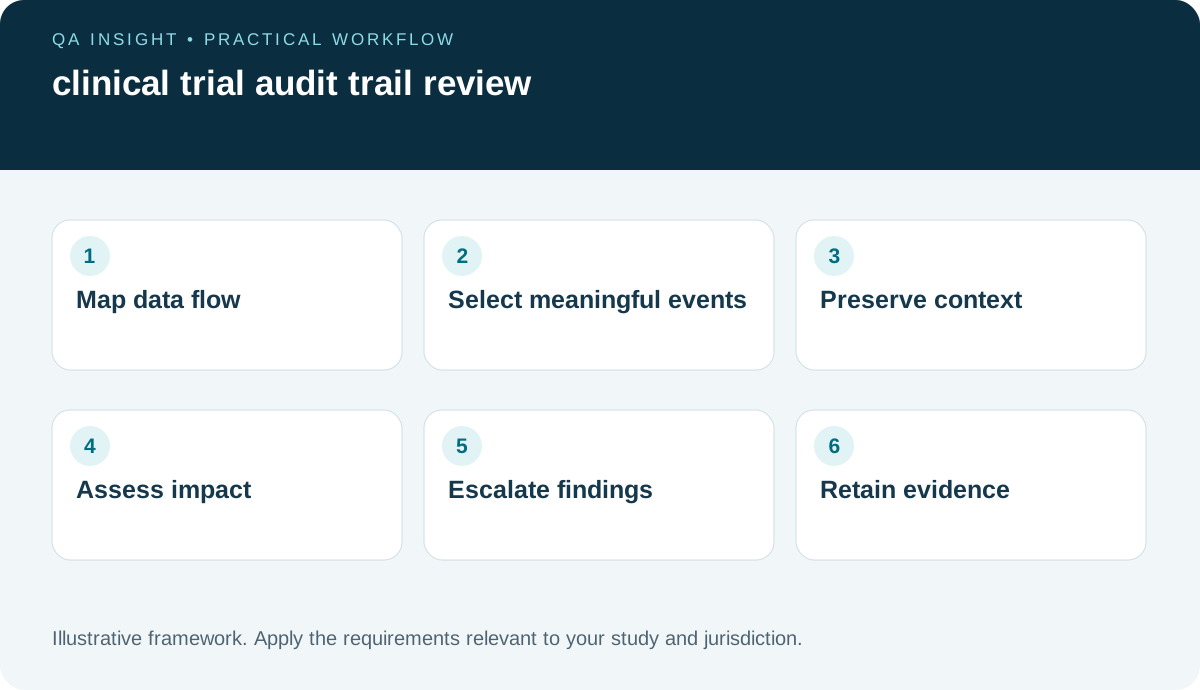
Build a clinical trial audit trail review process that prioritizes meaningful events, preserves context and documents proportionate follow-up.

Original AI-generated editorial illustration.
Clinical trial audit trail review is the purposeful examination of recorded changes and events to understand whether important electronic information remains trustworthy and whether unusual activity needs investigation. It is not simply reading every available event row. A useful review connects the data's role in the study, the system's behavior and the decisions that a finding could influence.
The right approach depends on the system, data, user roles and applicable framework. An export from a document platform will not answer the same questions as an electronic data-capture audit trail. Begin by understanding what the record represents and what the system does not capture, rather than assuming that a feature called audit trail supplies a complete account.
Map the data and its important changes
Trace how the information is created, transferred, corrected, reviewed and retained. Identify the authoritative source and any transformations between systems. Ask which changes could affect participant protection, important study results or the ability to reconstruct what happened. This map supplies the rationale for selecting meaningful events and review points.
FDA's electronic systems, records and signatures guidance provides relevant context for trustworthy electronic information in clinical investigations. Its applicability needs to be assessed alongside the relevant regulations and study circumstances. The workflow described here is a practical review model, not a claim that every electronic system requires an identical review schedule.
Understand the audit trail before using it
Establish which events are recorded and how users, roles, timestamps and reasons for change are represented. Determine whether the trail includes original and revised values, configuration changes, account activity or only a narrower set of transactions. Confirm how time zones, automated processes and system accounts affect interpretation.
Test the export with a known example. Can a reviewer connect an event to the underlying record and understand the sequence without undocumented vendor knowledge? If information disappears or becomes ambiguous when exported, preserve the context needed for interpretation. The guide to computerized system validation for clinical trials explains why these retrieval and export workflows deserve attention.
Choose review questions that matter
Define the questions before designing filters. A review might examine significant changes after an important review milestone, repeated revisions to a critical data field, unexpected privileged-user activity or a pattern inconsistent with the expected workflow. The purpose of each selection should be understandable to the person assessing the result.
Do not treat every late entry or corrected value as evidence of misconduct. Clinical information can require legitimate clarification and correction. A signal should lead to contextual assessment. An approach that produces many unexplained alerts may be less useful than a focused process that reliably identifies and resolves events with plausible consequences.
Assign roles and preserve appropriate access
Identify who prepares the information, who interprets the events and who makes decisions about potential impact. Reviewers need sufficient system knowledge and study context. Where privileged activity is being assessed, consider whether the reviewer has suitable independence from the person or function whose actions are under examination.
Coordinate access so that review does not unnecessarily reveal unblinded information or sensitive participant data. Use the least information needed to answer the question and follow the study's access arrangements. Agree what information a vendor must supply, and incorporate those responsibilities into clinical vendor quality agreements where appropriate.
Investigate a signal through its context
Consider a hypothetical pattern of repeated corrections to an important outcome field shortly before database lock. First confirm that the export and selection logic are accurate. Then examine associated queries, source information, access roles and documented reasons for change. Determine whether the pattern reflects a legitimate reconciliation exercise, inconsistent instructions or another issue needing escalation.
Preserve the evidence needed to support the conclusion. A screenshot without the relevant event context may be inadequate, while an uncontrolled export can create confusion over version and scope. Record what was reviewed, which questions were asked and how the available evidence supported the decision. Avoid conclusions stronger than the evidence permits.
Document findings and proportionate follow-up
A review record should identify the system, period, selection method, reviewed population, reviewer and outcome. Explain exclusions and important limitations. Where an issue is escalated, link the follow-up to its originating evidence so that a later reviewer can understand the relationship between the signal, investigation and decision.
Use CAPA effectiveness checks when a systemic weakness requires sustained correction. A single legitimate data correction may need no CAPA. Repeated failure to apply an agreed correction workflow may warrant broader action. The response should follow the consequence and cause, rather than the mere presence of an event in a log.
Maintain the approach through change
Reassess the review when the system, study design, data flow or access model changes. A filter that was meaningful before a software release may no longer capture the intended events. Retain versioned selection rules and confirm that important outputs remain interpretable after upgrades, transfers or changes to reporting tools.
At closeout, clarify retention and access to the event information needed to reconstruct the investigation. Include the relevant records in an eTMF inspection readiness assessment without assuming that everything belongs in a single repository. Cross-references can be useful when they remain reliable and explain where the authoritative evidence is held.
Interpret accounts and automated events carefully
An account identifier is not always sufficient to establish who performed an activity or why it occurred. Confirm how shared service accounts, scheduled jobs and delegated functions appear in the trail. Investigate unclear attribution through approved records and system knowledge rather than assuming that an unusual account name proves inappropriate conduct. Record unresolved limitations. Where the system cannot supply the context needed for a meaningful conclusion, address that weakness in the system assessment and review design instead of presenting the available export as a complete history.
Make review part of a coherent oversight model
Combine audit-trail information with other quality signals and operational knowledge. It should complement monitoring, data management and independent audit rather than silently duplicating their work. Define how teams share material concerns and avoid reviewing the same signal repeatedly without an accountable decision.
The site's clinical documentation review and independent GCP auditing resources provide related context. QA Insight's clinical quality services can support appropriate assessment and training. The useful outcome of audit trail review is a reasoned understanding of important electronic events, supported by evidence that another qualified reviewer can follow.
Primary sources and further reading
This article provides general professional information. Confirm the requirements and decisions applicable to the particular investigation.