
At a glance
Identify critical-to-quality factors in clinical trials and connect them to feasible controls, useful signals and accountable decisions.

Original AI-generated editorial illustration.
Critical-to-quality factors in clinical trials are the features of study design and conduct that most influence participant protection and the reliability of the study's conclusions. Identifying them helps a team decide where careful design, strong controls and timely review will matter most. The purpose is focus: a useful set of factors makes decisions clearer rather than labelling every activity critical.
A critical factor is not the same as a task, a risk or a metric. A factor describes what needs to remain dependable. A risk describes how that condition might fail. A control reduces the chance or consequence of failure, while a metric supplies information about performance. Keeping these concepts separate makes the resulting quality plan easier to use.
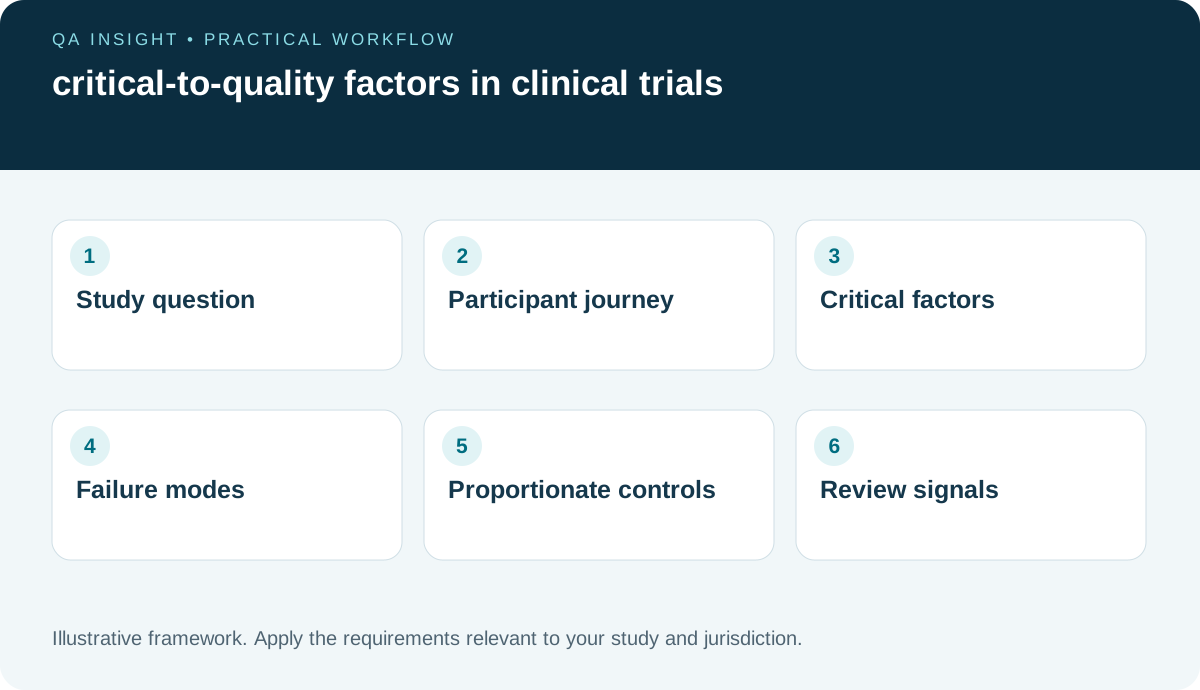
Start with the study question
Ask what the study must establish and which evidence will support that conclusion. Work backwards from the primary objectives, important safety information and participant experience. A process that is critical in one study may be less consequential in another. Copying a previous trial's list can miss the features that make the new investigation difficult.
ICH E8(R1), as described by EMA, places quality considerations and the identification of critical factors within study planning. A practical workshop can translate that concept into operational questions. Which errors would make an endpoint difficult to interpret? Where could participants experience avoidable harm or an unnecessarily burdensome process?
Bring different perspectives into the discussion
Include clinical operations, medical, statistics, data management, safety, quality and relevant vendors. Involve investigator-site perspectives and participant input where appropriate. Different functions see different failure modes: a schedule that looks straightforward centrally may be difficult to perform at a busy site, and a technically sound measurement may be burdensome for participants.
Give participants a concise study outline before the workshop. Ask each function to identify a small number of concerns and explain the consequence of each. This preparation makes the discussion concrete. It also prevents the loudest voice from defining quality solely through the activities that its own department happens to manage.
Describe the factor before selecting the metric
Consider a hypothetical trial whose main conclusion depends on a time-sensitive outcome assessment. “Complete the visit tracker” is a task. “The primary outcome is assessed consistently within the justified assessment window” is a quality factor. Potential risks include unclear scheduling instructions, unavailable equipment, inconsistent assessor training or an impractical visit sequence.
Once the factor is clear, the team can select useful signals, such as the proportion of assessments outside the window or the reasons for missing results. These signals should inform a decision. Read the related guide to quality tolerance limits in clinical trials before assuming that every site indicator needs a trial-level numerical limit.
Test whether the protocol creates avoidable risk
Quality planning should influence the design rather than only produce additional monitoring. Check whether eligibility criteria can be applied consistently, whether assessment instructions are understandable and whether required information is actually available. A simplified process may protect a critical factor more effectively than an elaborate control placed around an unnecessarily difficult task.
Use a brief rehearsal of the participant journey. Follow screening, consent, visits, samples, assessments and follow-up. Identify handoffs, time pressures and opportunities for misunderstanding. Record design changes considered, including decisions not to change the protocol. This creates a useful explanation of how the team evaluated feasibility and competing priorities.
Connect each factor to ownership and evidence
For each selected factor, record its rationale, credible failure modes, controls, information sources and accountable decision maker. Explain what would trigger additional review and where that review would be documented. The result should fit the existing study operating model instead of creating a parallel governance structure that nobody has time to maintain.
Outsourced activities deserve particular attention. A vendor may collect the information while the sponsor retains the responsibility for evaluating it. The article on clinical vendor quality agreements shows how to define that handoff. A quality factor without a clear route from information to decision is unlikely to remain visible during a busy study.
Use proportionate controls
Not every factor needs another checklist or an additional meeting. Consider whether existing controls already address the risk and whether their performance can be demonstrated. Controls might include clearer protocol instructions, targeted training, automated edit checks, centralized review, focused monitoring or an independent assessment. Select the combination that addresses the specific failure mechanism.
Document why the approach is proportionate. A lower-intensity control should have an explanation, just as a resource-intensive control should. Teams developing a broader framework can connect these choices to clinical quality management plan development and the site's discussion of a risk-based approach to clinical quality management.
Review the factors when the study changes
Revisit the assessment after meaningful protocol changes, new safety information, altered vendor arrangements or evidence that an assumption was wrong. A new data source or assessment method may change which controls matter. Record the reason for the review and update affected plans, responsibilities and training together, rather than allowing documents to drift apart.
A useful management review asks whether the selected factors still explain the study's important quality concerns. If everything is green while operational teams repeatedly encounter serious problems, the factor set or signals may be incomplete. The appropriate response is to examine the model, not automatically add more measurements to the same dashboard.
Check whether a new team member can use the output
Give a proposed factor card to someone who did not attend the workshop. Ask what could go wrong, which control matters and who would respond. If those answers require the original authors to reconstruct the discussion, make the rationale and ownership clearer before approving the document.
What does a usable output look like?
The final output can be a concise table linking each factor to its rationale, risk, control, owner and review evidence. Keep the reasoning understandable to a new team member. A process owner should be able to explain how information will lead to action without needing a specialist to interpret a complex scoring system.
Use an ICH E6(R3) gap assessment to test whether those connections are embedded across the organization. QA Insight's clinical quality services can support related assessment, audit and training needs. The useful measure of a critical-to-quality exercise is whether it improves decisions about the study, not how many factors appear in its spreadsheet.
Primary sources and further reading
This article provides general professional information. Confirm the requirements and decisions applicable to the particular investigation.