
At a glance
Understand quality tolerance limits, distinguish trial-level signals from site indicators, and build a documented review and escalation process.

Original AI-generated editorial illustration.
Quality tolerance limits in clinical trials help a team recognize when variation in an important aspect of trial conduct warrants investigation at the study level. They are useful only when the measure, rationale and response process are clear. A threshold on a dashboard cannot protect quality if nobody knows what crossing it means or who must evaluate the signal.
A limit is not an automatic declaration that a study is invalid. It is a prompt to examine the circumstances, consequences and appropriate response. Equally, staying inside a limit does not demonstrate that every participant, site or process is adequately protected. Trial-level measures need to sit alongside local oversight and professional judgment.
Distinguish trial-level signals from site indicators
A site indicator may identify a local issue that deserves operational follow-up. A trial-level quality measure asks whether the overall study remains within a justified range for something important to its conduct or interpretation. The distinction depends on the purpose and decision attached to the measure, not simply on whether its value is expressed as a percentage.
The ICH E6(R3) Principles and Annex 1 discuss managing risks to quality using proportionate approaches and relevant measures. Teams should check the terminology and expectations in the version and jurisdiction applicable to their study. An older template using the term QTL should not prevent the team from explaining its actual quality-management approach.
Choose the risk before the number
Start with a defined threat to participant protection or the reliability of results. Then ask what information would make a developing problem visible soon enough to act. If the selected measure mainly reflects administrative activity, it may be a useful operational metric without being a good candidate for a study-level quality limit.
For example, a hypothetical study could monitor missing primary-outcome assessments because extensive missingness would complicate interpretation. The measure should be connected to an identified critical-to-quality factor. The team should also investigate why assessments are missing, since different causes may require very different responses.
Write a precise operational definition
Specify the numerator, denominator, population, time window, data source and handling of incomplete information. State whether the measure uses cumulative data, a moving period or a defined milestone. Document any exclusions. Two analysts should obtain the same result from the same underlying records without having to make undocumented assumptions.
Consider timing carefully. A denominator based on everyone enrolled may conceal a problem if many participants have not yet reached the relevant assessment. A very small denominator may create unstable percentages. Discuss these issues with statistical and operational colleagues before approving the definition, and retain examples showing how unusual cases will be treated.
Explain the rationale for the range
Consider the study's design, scientific objectives, participant population, feasibility information and relevant prior experience. Explain the uncertainties and assumptions. A convenient round number or a threshold copied from another study is not a sufficient rationale when the consequences, data maturity and operational conditions are materially different.
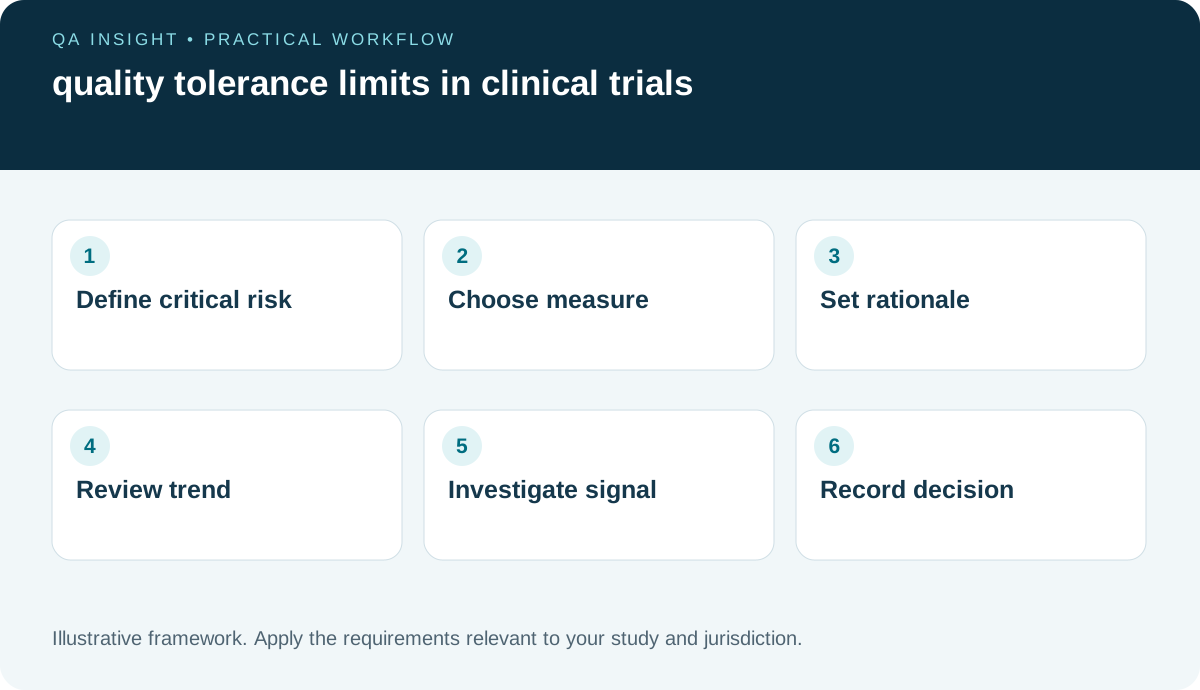
There is no universal percentage that works for every trial or quality issue. Any numbers used in a training graph should be clearly identified as hypothetical, not as recommended limits or regulatory benchmarks. The graph accompanying this article describes a decision process rather than presenting an invented industry performance dataset.
Define what happens when a signal appears
Assign an accountable reviewer and specify the information needed for an initial assessment. The first questions should include whether the data are accurate, whether the definition has been applied correctly and whether the signal reflects a meaningful change. Agree an escalation route appropriate to the potential consequence, including access to relevant medical or statistical input.
The review should produce a documented decision, even where no additional action is justified. Record the explanation, responsible person and any follow-up. Where a systemic weakness is identified, use a proportionate corrective process and planned CAPA effectiveness checks. A resolved dashboard flag is not the same as a resolved underlying risk.
Look beneath an acceptable overall result
Aggregate measures can hide clusters. An overall value may look acceptable while a particular region, site, visit type or participant subgroup experiences a persistent problem. Explore meaningful patterns without turning every possible subdivision into another formal threshold. Keep the analysis connected to plausible risks and decisions.
Review combinations of signals as well. Missing assessments, repeated rescheduling and a rise in participant withdrawals may together suggest a feasibility problem that none of the measures explains alone. Operational discussion supplies context that a traffic-light display cannot. An independent clinical quality assurance risk assessment can help test whether important patterns are being missed.
Control changes to definitions and limits
A study may generate legitimate reasons to revise a measure, but changes should not be used merely to make an unfavorable result disappear. Retain the original definition, reason for change, approval and impact assessment. Explain how earlier data will be interpreted and whether other plans or communications need updating.
The same discipline applies to technical changes. Confirm that revised queries, exports or dashboard calculations produce the intended result. The guide to computerized system validation for clinical trials provides a related way to think about testing important workflows and maintaining evidence through change.
Account for the delay between activity and visibility
A measure can be accurately calculated yet arrive too late to support a useful decision. Map the delay between the underlying activity, data entry, review and dashboard refresh. Explain what remains invisible at each review point. If the purpose is early detection, consider whether another information source is needed during that interval. Keep provisional information distinguishable from reconciled data, and avoid comparing periods as though their maturity were identical. The review record should show what the team knew when it made its decision.
Make the review useful to management
Report the condition, interpretation and decision rather than presenting a chart without a narrative. Management should understand which assumptions remain sound, which risks have increased and where resources or decisions are needed. Distinguish a temporary data issue from a substantive concern about trial conduct or information reliability.
FDA's risk-based monitoring questions and answers provide related oversight context. Combine that perspective with a clinical quality management plan and clinical QA support. A useful quality tolerance process turns observations into accountable, evidence-based decisions throughout the study.
Primary sources and further reading
- ICH: E6(R3) final guideline, Principles and Annex 1
- FDA: Risk-based monitoring questions and answers
This article provides general professional information. Confirm the requirements and decisions applicable to the particular investigation.