
At a glance
Plan an ICH E6(R3) gap assessment that connects clinical processes, evidence, risk priorities, ownership and measurable implementation.

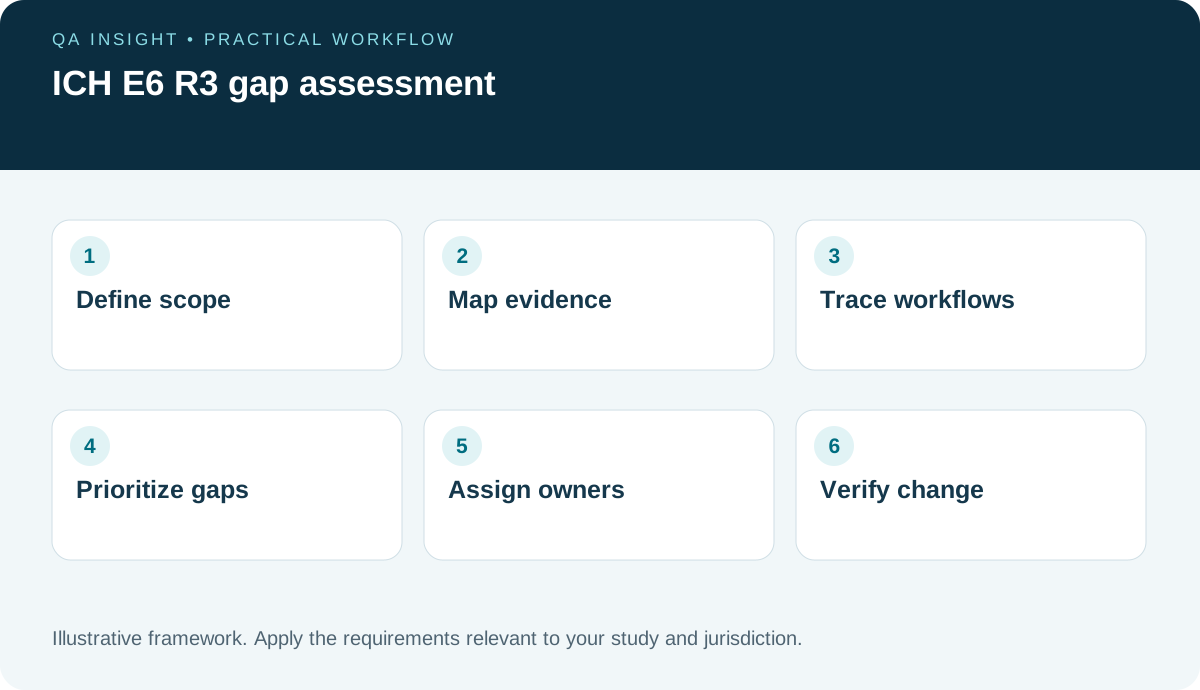
Original AI-generated editorial illustration.
An ICH E6(R3) gap assessment compares the way a clinical organization actually works with the guidance applicable to its studies. Its useful output is a prioritized implementation plan supported by evidence, owners and acceptance criteria. A list of revised procedures is insufficient if the people running the study cannot explain how their decisions, systems and oversight practices have changed.
Begin with a clear distinction between a gap assessment and an audit. The assessment helps plan a transition and understand readiness. An independent audit tests selected activities against defined criteria. The two activities can support one another, but calling an assessment an audit does not make its evidence stronger.
Confirm the version and regional context
EMA identifies the E6(R3) Principles and Annex 1 as effective in the European Union from 23 July 2025. Its published information gives Annex 2 a future EU effective date of 15 January 2027. These dates should not be treated as a single worldwide implementation deadline. Record the jurisdiction, study type, applicable version and relevant transition decisions in the assessment scope.
The EMA guideline page is a starting point for checking that context. Ask regulatory colleagues to confirm applicability before converting an interpretation into a mandatory company rule. The practical approach below is an assessment framework, rather than a replacement for the guideline or a jurisdiction-specific legal opinion.
Scope the assessment around real workflows
Define which studies, departments, systems and outsourced activities are included. A small sponsor using several vendors needs a different evidence map from a large organization with established internal functions. Record exclusions explicitly, including their rationale and the person accepting them. Otherwise, an unexamined interface can disappear between different teams' assessment plans.
Choose a manageable set of workflows: study design, risk review, informed consent, safety information, data handling, computerized systems, vendor oversight and essential records. For each workflow, identify the decisions that matter and where their evidence should exist. The guide to critical-to-quality factors in clinical trials helps connect this scope to the study's actual objectives.
Compare documents with operational evidence
Collect procedures, plans, agreements, training records and system descriptions, then sample records showing how those controls operate. A procedure may require escalation, yet meeting minutes may show that unresolved issues circulate without a decision. That difference is more informative than the presence of a paragraph containing the correct terminology.
Use short interviews to reconstruct a recent example. Ask the process owner what happened, who decided, which information was available and how the outcome was recorded. Follow the example across organizational boundaries. Where a CRO performs the activity, compare the sponsor's understanding with the vendor's account and with the agreement governing their responsibilities.
Write gaps that can be acted on
A useful gap statement describes an expectation, the observed condition, the supporting evidence and the potential consequence. Avoid findings such as “improve oversight” or “update training,” which leave the owner to discover the problem again. Separate missing documentation from an ineffective process, and distinguish a local exception from a wider system weakness.
For example, a hypothetical assessment might find that a sponsor receives monthly vendor metrics but has no documented mechanism for evaluating repeated critical data issues. The gap is not simply a missing report. It concerns how signals are assessed and translated into decisions. Additional reporting alone may make the process busier without improving control.
Prioritize by consequence and exposure
Evaluate potential effects on participants, reliability of results and the organization's ability to demonstrate appropriate study conduct. Consider how often the weakness is encountered and whether existing controls are likely to detect it. A simple, explained prioritization is more valuable than a complicated numerical score that creates an appearance of precision.
Prioritization should influence sequencing, resources and interim controls. Some issues can wait for a planned procedure revision; others need an immediate operational response while a durable solution is developed. Connect these decisions with the organization's existing clinical quality assurance gap analysis process so the transition does not create a competing action register.
Build an implementation plan with acceptance criteria
Assign one accountable owner for each action, even where several functions contribute. Define the deliverable, dependencies, target date, interim protection and evidence required for acceptance. Replace “train staff” with an outcome such as demonstrating that the relevant roles can apply the revised decision process to a realistic scenario.
Include contracts, technology configuration and operating plans where needed. Procedure changes cannot repair an access restriction or a missing vendor handoff by themselves. The article on clinical vendor quality agreements explains how to make those interfaces explicit without relying on broad statements that everyone will maintain compliance.
Use the first review meeting to test the plan
Before launching a large workstream, ask the team to assess one workflow together. Compare how participants interpret the expectation, what they consider sufficient evidence and how they describe the potential consequence. Resolve those differences early. Otherwise, separate assessors may produce action lists that look comparable but apply very different standards of evidence and significance.
Take a recent vendor issue as the pilot example. Follow the notification, assessment, decision and subsequent evidence. Ask whether the proposed action would change that sequence if the same circumstances occurred again. This pilot also reveals practical obstacles, such as records that cannot be retrieved or decisions with no clear owner. Use the learning to refine the assessment method, communicate expectations and estimate the resources needed for the remaining scope.
Verify the change before declaring readiness
Review a sample of work completed after implementation. Can the team retrieve the evidence, explain its decision and show that escalation occurred when expected? For system changes, check the relevant testing and release records. For record-management changes, use an eTMF inspection readiness checklist to test retrieval and traceability rather than folder appearance.
Close the assessment with a clear management decision: which gaps are resolved, which remain open, what interim measures apply and when effectiveness will be reviewed. Preserve the rationale, not just the status. QA Insight's clinical quality management gap assessment resources and clinical QA services provide related context for turning a transition exercise into sustained operational improvement.
Primary sources and further reading
This article provides general professional information. Confirm the requirements and decisions applicable to the particular investigation.