
At a glance
Improve protocol deviation management with consistent identification, impact assessment, reporting decisions, trend review and proportionate CAPA.

Original AI-generated editorial illustration.
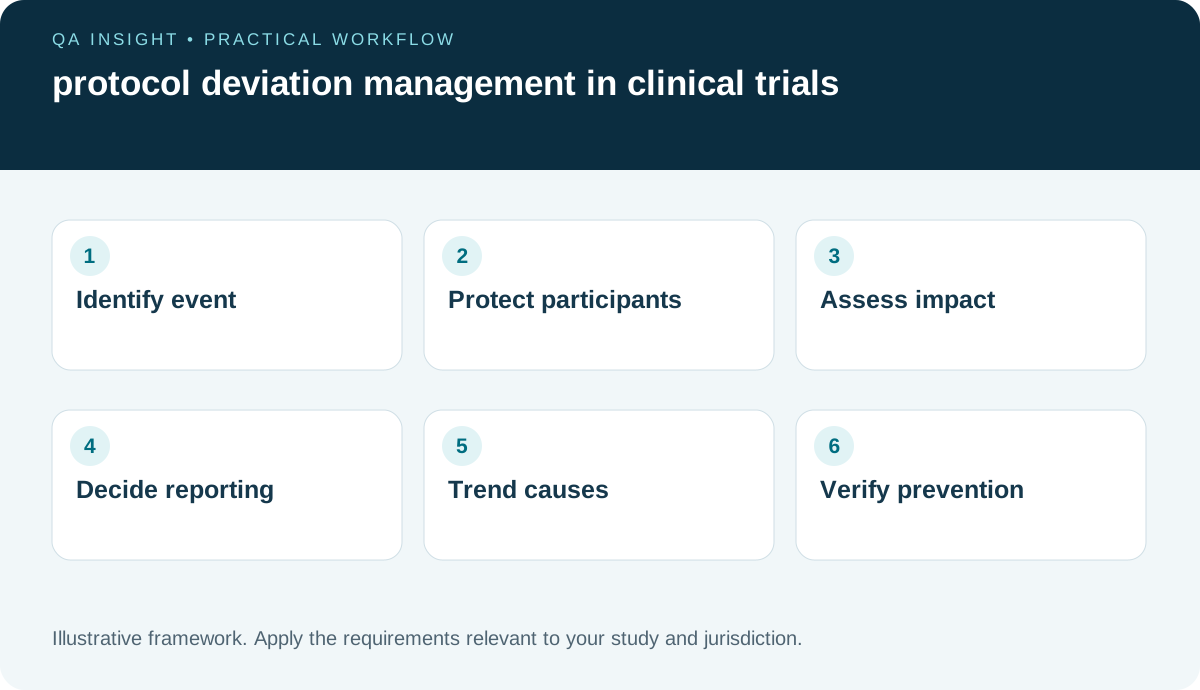
Protocol deviation management in clinical trials is the organized process of identifying departures from the protocol, assessing their implications, making appropriate reporting decisions and preventing avoidable recurrence. Its purpose is to protect participants and preserve reliable interpretation of the study. A complete deviation log is useful evidence, but a log alone does not demonstrate effective management.
Use consistent working definitions and decision routes throughout the study. The same event should not be classified differently merely because it occurred at another site or was reviewed by another function. At the same time, consistency should not mean ignoring context. The potential consequence depends on what happened, who was affected and which information or protections were involved.
Distinguish operational terminology from binding requirements
FDA's December 2024 document on protocol deviations in clinical investigations is identified on the agency's website as draft guidance, not for implementation. It should not be presented as a final, universally binding classification system. Check the applicable regulations, approvals, protocol and reporting arrangements for the specific investigation.
Explain the organization's working categories, the rationale behind them and the route for uncertain cases. Terms used in an internal quality system may not map exactly to terms used by an authority or ethics committee. Preserve those distinctions so that operational convenience does not replace a considered reporting decision.
Make identification reliable
Define how potential deviations can be recognized by sites, monitors, data managers, safety teams and vendors. Include routes for issues discovered through centralized review or record reconciliation. People should know what to record initially, how to protect participants where relevant and where to obtain prompt advice if the significance is unclear.
Do not rely solely on a periodic monitoring visit to discover problems. A late assessment, missed procedure or inconsistent application of an eligibility criterion may be visible earlier to another function. The guide to critical-to-quality factors helps identify which activities deserve particularly reliable detection and communication.
Capture facts before assigning a label
Record what occurred, when it occurred, when it was detected, the relevant protocol expectation and the available evidence. Identify affected participants and records through appropriate identifiers and access controls. Separate confirmed facts from assumptions, and note information that is still being investigated rather than filling gaps with a premature explanation.
In a hypothetical case, a participant's assessment occurs outside the specified window. The initial record should establish the actual timing, applicable instructions and relevant circumstances. A statement that the site forgot the visit is inadequate if the evidence instead suggests an ambiguous scheduling tool or a coordination failure involving another provider.
Assess impact with the right expertise
Consider participant rights, safety and well-being, the reliability of important data and the ability to interpret the study. Involve medical, operational, statistical or other relevant expertise where needed. Document the rationale for significance, especially where the same type of event can have different implications under different circumstances.
Keep the assessment proportionate, but do not let administrative categories conceal a serious concern. A seemingly small process departure can matter when it affects a critical assessment or protection. Conversely, an event should not be described as compromising the entire study without evidence supporting that conclusion. The record should explain both the concern and its limits.
Separate reporting decisions from internal tracking
Identify who evaluates reporting obligations to the sponsor, ethics committee, authority or other relevant recipient. Use the applicable framework and timelines rather than assuming that an internal classification automatically determines every external report. Document the decision, responsible person and basis, including an explanation where no additional report is considered necessary.
Coordinate related safety, serious-breach or other processes where applicable without treating them as interchangeable labels. Define how the teams exchange information and avoid contradictory records. Clinical vendor quality agreements can make these responsibilities clearer where a CRO or specialist provider identifies or manages part of the event.
Investigate causes and choose proportionate action
Address the immediate situation and determine whether broader investigation is justified. Repeated events, a significant consequence or evidence of a systemic weakness may require more than local correction. Examine instructions, workload, feasibility, tools, training, interfaces and supervision as appropriate to the facts.
Retraining should have a reason connected to the cause. If the workflow is impractical or responsibilities are ambiguous, repeating the same instructions is unlikely to solve the problem. Define how the action will be evaluated through CAPA effectiveness checks rather than accepting an attendance record as proof that recurrence has been prevented.
Review patterns without losing context
Look across sites, periods, visits, vendors and event types for meaningful patterns. Use denominators that reflect exposure: raw counts can be misleading when sites differ greatly in enrollment or activity. Preserve the ability to examine individual events, since an aggregate trend does not describe every participant's experience or every local risk.
Connect trend review with relevant trial-level quality measures and operational discussion. A stable overall percentage can hide a concentrated local problem. Ask whether the information is leading to a decision and whether previous actions changed the conditions that produced the events.
Reconcile duplicate reports of the same event
The same event may appear in monitoring notes, a data query, a vendor tracker and the site's deviation log. Establish how the team recognizes those connections without losing the original records. Duplicate entries can exaggerate trends, while premature merging can conceal separate events with different implications. Retain appropriate identifiers and cross-references, and document material reconciliations. A reviewer should be able to distinguish one event reported through several channels from several related events that suggest a broader process weakness.
Maintain a traceable study record
Link the event record, impact assessment, reporting decision, correspondence and follow-up actions. Control revisions so that a later reviewer can understand how the assessment developed. Reconcile important information before reporting or closeout, while retaining the original context rather than rewriting the history to make the record appear simpler.
Related inspection readiness support and clinical documentation review resources explain why that traceability matters. QA Insight's clinical QA services can support appropriate assessment and training. Effective deviation management turns individual events into informed decisions and practical learning while keeping participant protection and credible study information central.
Primary sources and further reading
This article provides general professional information. Confirm the requirements and decisions applicable to the particular investigation.