
At a glance
Design clinical trial CAPA effectiveness checks that test root causes, exposure, recurrence and sustainable process improvement.

Original AI-generated editorial illustration.
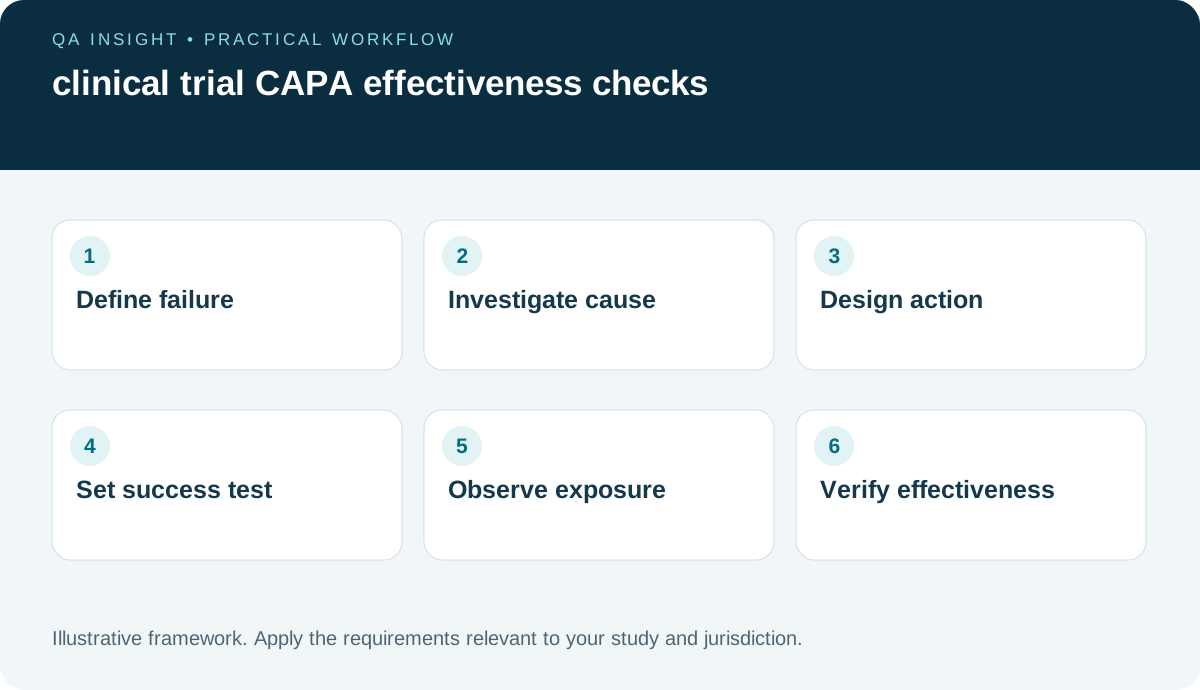
Clinical trial CAPA effectiveness checks test whether a corrective and preventive action has addressed the underlying problem in practice. They should examine the relevant failure mechanism, the opportunity for recurrence and the evidence of sustained improvement. Completing an action, updating a procedure or recording attendance at training does not by itself establish that the action worked.
Plan the effectiveness check when designing the CAPA. That timing forces the team to explain what success would look like and how it could be observed. If an action cannot be connected to a meaningful test, its relationship to the root cause may be weaker than the action plan suggests.
Separate correction, implementation and effectiveness
A correction addresses an identified instance, such as resolving a missing signature where an appropriate remedy is possible. Implementation confirms that the agreed action was completed. Effectiveness considers whether the improved process now prevents, detects or controls the relevant failure. These stages may require different evidence and should not be collapsed into one closure checkbox.
MHRA's discussion of GCP inspection expectations emphasizes proportionate, measurable CAPA and follow-up through effectiveness checks. Its more recent inspection-response guidance on evidence and verification reinforces the importance of addressing underlying issues. The following framework translates that principle into practical questions for a study team.
Write the failure clearly
Define the observed condition, its scope and its potential consequence. Avoid beginning with a preferred solution such as retraining. Explain what should have happened and what evidence shows the difference. Determine whether the issue is isolated to a record, site or study, or whether comparable processes may share the same weakness.
Consider a hypothetical case in which revised safety instructions repeatedly fail to reach the staff who need them. Correcting the current distribution list may resolve the immediate problem. The investigation should also examine how role changes, vendor contacts, acknowledgements and unresolved delivery failures are managed. Those mechanisms determine what an effectiveness check needs to test.
Connect the action to an evidenced cause
A root-cause statement should explain the mechanism of failure and be supported by the investigation. Labels such as human error, poor communication or insufficient training are starting points rather than complete explanations. Ask why the process allowed the error to occur, why existing controls did not detect it and whether the same conditions remain elsewhere.
For the distribution example, the cause might involve an unowned handoff between the study team and a vendor's contact-management process. A revised communication procedure alone would not repair that interface. The article on clinical vendor quality agreements explains how to make responsibility, evidence and escalation at such handoffs explicit.
Define success before observing the result
State the evidence that would support an effectiveness conclusion, the review population, the observation period and the responsible reviewer. Explain why the selected sample and timing are suitable for the risk. A fixed sample size or a standard waiting period should not replace reasoning about how the process actually operates.
In a low-frequency process, a calendar month without recurrence may provide almost no information. The improved process may not have been used. A controlled rehearsal can supply useful early evidence, followed by review after real exposure occurs. Record the distinction between a simulation and actual operational performance so the conclusion remains proportionate.
Measure the right opportunity for recurrence
Identify the denominator that matters. The number of days since implementation is often less useful than the number of relevant transactions, staff changes, visits or data transfers. Define how the team will recognize a recurrence and whether near misses or delayed detection should also be considered.
Check that the source used for monitoring can detect the problem. An absence of recorded deviations is weak evidence if staff do not consistently recognize or report them. Link the review to an effective protocol deviation management process and consider independent sampling where the consequence justifies it.
Look for unintended effects
An action can reduce one error while creating another problem. A new approval step may improve control but delay time-sensitive communication. A restrictive system setting may prevent an inappropriate change while making legitimate corrections difficult to document. Include a short review of these trade-offs rather than treating the targeted metric as the only outcome.
Ask the people using the revised process whether the action is workable under routine conditions. Compare their account with records and relevant signals. Their feedback does not replace evidence, but it can identify workarounds that a document review would miss. Related clinical QA process improvement consulting resources discuss this connection between process design and actual use.
Make a defensible closure decision
Record the reviewed evidence, results, limitations and conclusion. Identify who accepted the conclusion and why. If the evidence is insufficient, extend the observation or revise the plan. If the action failed, reopen the investigation rather than repeatedly resetting a due date without reconsidering the cause.
Distinguish an effective action from an acceptable interim control. An interim measure may reduce current exposure while a durable solution is developed, but its continuing use should be intentional and reviewed. Connect related actions across studies where the same underlying process is involved, so improvement is not confined to the original finding.
Ask what would challenge the success claim
Before closing the CAPA, identify evidence that would contradict the proposed conclusion. Could the error recur in another shift, vendor team or study configuration? Did the reviewed sample include the circumstances that originally caused failure? This question helps reduce confirmation bias without making every effectiveness review unnecessarily large. Where uncertainty remains, record it and decide whether additional observation is justified. A transparent, qualified conclusion is stronger than an unqualified declaration of success supported by a narrow or unrepresentative sample.
Use the learning across the quality system
Review recurring causes, overdue effectiveness checks and actions that repeatedly fail. These patterns may reveal problems with investigation quality, ownership or management decisions. Keep the discussion focused on learning and evidence, rather than rewarding a high volume of closed actions without examining what closure represents.
Use corrective action support and an ICH E6(R3) gap assessment where a wider system review is appropriate. QA Insight's quality management and audit services provide related support. A useful CAPA effectiveness check explains why the organization can reasonably expect the improved process to behave differently.
Primary sources and further reading
This article provides general professional information. Confirm the requirements and decisions applicable to the particular investigation.